|

|

|

|

|
Renaissance Storybooks
John Haberin New York City
The Hours of Catherine of Cleves
So Jean-Paul Sartre had it wrong. Hell is not other people. It is more intimate and closer to oneself. It is one's home as one's castle, a bright home fire, and a furry animal or two. 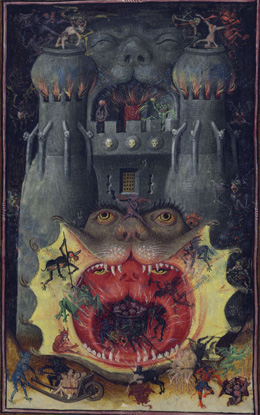
That image is from The Hours of Catherine of Cleves. The furry animal is a lion and its jaws the mouth of Hell. They spread to reveal a yellow, reptilian webbing and, in its fiery interior, yet another pair of eyes. A darker version of the beast stands guard over the castle roof. No one escapes its massive stone, with skulls in place of windows and devils in its turrets.
The Morgan Library ranks it among the most "scary and inventive" images of the early Renaissance. It is also just one miniature, from one of the largest surviving texts of its time. A companion show of Flemish illumination adds eighteen other books as context. A related review looks at "Pages of Gold," also at the Morgan, which extends the story across the continent.
Nothing, though, beats immersion in that one Book of Hours. Besides their pleasures, its pages offer a status report on the Northern Renaissance, when it was just taking shape. They also offer a peek at family and territorial politics. If Catherine of Cleves had her own private hell, she made the most of it.
She herself was Hell
Catherine was barely twenty-three in 1440, but life for the aristocracy moved quickly then. She was betrothed at age six to Arnold of Egmund, duke of Guelders and count of Zutphen. (Before one makes him into too big a villain, he was just thirteen himself.) Seven years after that, they married—and ten years and six children later, they separated. The father disinherited a son, entire cities took sides, and then things get really complicated. First, though, she commissioned a Book of Hours.
A Book of Hours is a book of prayers for a queen, for eight set times of day. For Catherine, it became instead a monument. It ran to one-hundred sixty-eight miniatures, and all but eleven survive. An unknown hand created series for each day of the week—on such themes as the life of the Virgin, the Passion, and the popular legend of the true cross. He pairs full-page images with insets on the right-hand page of text, often Psalms, plus the expected decorative borders. He adds dozens more for suffrages, or sufferings of the saints.
One can see the work's scale as a woman's private museum. One can see it, too, as her assertion of independence. She kneels in prayer on the very first page, with her family coat of arms before her husband's. She appears twice more as well, giving alms and at the base of the cross, across from Mary. Note the curators, Rob Dückers and Ruud Priem of the Museum Het Valkhof in Nijmegen with Roger S. Wieck of the Morgan, even Jesus must pause for her before dying. In Arnold's one appearance, he comes paired instead with the devil, and the devil gets the last word in their argument.
I could play devil's advocate. Patrons turn up often enough in religious scenes, and only the devil would object. Still, a biographical reading has a point. It shows in Catherine's assumption of the virtues—not just in distributing alms, but in a book of so many prayers. It shows in her identification with the Virgin, who has the first day's set. Mary managed a son without needing sexual relations with her husband, too.
No one can know who invented what detail—the patron or the artist. The whole fashion for illuminated manuscripts depended on a growing private market, not just the art of churches. It points, too, to a growing literacy. A woman like Catherine was entitled to a few barbs here and there, and the work comes alive in its clever juxtapositions. The border for Saint Lawrence, who died roasted alive, has cages for catching fish on their way to the grill. Across from the mouth of Hell on the facing page, clergy give absolution, but the hooded monks behind them look grimmer than purgatory.
To my eyes, the mouth of Hell, too, is more witty than terrifying. Anyone expecting the torments of Hieronymus Bosch or Michelangelo should look elsewhere. Except for some naked people shipped off in ox carts at the bottom, the devils mostly go after one another. On the border, the seven deadly sins playfully pop out of a dragon's mouth, on a scroll. The stone and fiery colors really do promise creature comforts. Even the lion seems to smile.
More of comfort than revenge
The entire work speaks more of comfort than revenge. Saints carry the usual emblems, often the instruments of martyrdom, but they do not suffer. Image after image speaks of human warmth and tenderness. It shows in the choice of a folk tale, like the legend of the true cross. And that legend begins with a gesture of love. At his death, Adam's son places a flowering branch in his mouth.
The images rarely depart from obvious choices. When they do, they reach for mundane matters, like a burial. They prefer closed spaces to vast landscapes, like paired interiors for the Holy Family. In one, Joseph planes a board while Jesus uses a walker to take his first steps. In the other, he naps while Jesus nurses. The furniture arrangement plays down symmetry and linear perspective to convey a real intimacy, like entering a private room.
Borders aim for the recognizable, like large butterflies or a crab, rather than ornate detail. Most images have a central peak—like a throne, a cross, a hill, or a tomb. It keeps the main event enclosed, with an occasional revelation rising up from behind. Colors have a consistent warmth, like the muddy crimson of Jesus's robe. He, too, treads humbly and lightly, even in stepping on his cross to arise from death. The God who creates Eve looks like a kindly grandpa.
Some of this reflects Catherine and the artist. Most agree that one person painted all the images. I hesitate to say, but it is plausible. Some work looks more primitive, such as the interior of the Holy Family, but the artist could have learned over the course of things. Besides, it all shares that humanity. That feeling outlasts whatever family animosity may have motivated the book.
Some, too, reflects its time. Important or not, this book came at the end of something. Around 1400, manuscript illuminators were the innovators. They defined the elegant International Style and laid the groundwork for the Renaissance, much as sculpture did in Italy. Odds are, Jan van Eyck himself had a hand in the medium—specifically, Hand G in another Book of Hours. Not that anything is certain when it comes to Jan van Eyck, his older brother Hubert, and his pupil, Petrus Christus.
The Hours of Catherine of Cleves comes just after that and well after the Crusader Bible and J. P. Morgan's Bibles. It sums up something, including a new style. It looks closest to Robert Campin, probably the first in a line of Northern Renaissance panel painters in oil. They share a similar facial type and a pleasure in ordinary activities, like Joseph's carpentry. Even so, the Master of Catherine of Cleves lacks Campin's skillful line, heavy shadows, gaunt features, layered symbolism, and passionate religiosity. He is too quiet, prayerful, and funny.
Between the cracks
Not that manuscript illumination ceased in 1440. The Morgan has told that story for the Book of Ruth, Jean Poyer and others, and the Morgan tells it again in its smaller show. "Flemish Illumination in the Era of Catherine of Cleves" actually starts before that era but ends well after. It includes examples of the International Style that preceded the Renaissance, with subtle colors and balletic movements. When Saint Christopher carries the infant Jesus across a stream, he steps gingerly, as if in and out of potholes. Early borders run to gilt and interwoven foliage, and two red halos have patterning like starlight.
The room includes the Master of Jean Chevrot, who may have collaborated with van Eyck on Hand G. It continues to the end of the century for its most noted names, Simon Marmion and Simon Bening. Borders become trompe l'oeil, and pastel reds and blues give way to deep greens and purples. King David and others look more and more psychologically acute and a lot earthier, thanks to such influences as Hugo van der Goes. Enormous display cases make the books distant and hard to see. They end, though, with a fabulous night scene.
In a sense, the Cleves Master falls between the cracks. Unlike the Limbourg brothers a generation before, he achieves rather than innovates. He could not imagine sweeping views of distant cities, like his great predecessors. He could not imagine the skilled realism that came after. It does not help that he worked in Utrecht, while art's leading edge had moved to present-day Belgium. Textbooks tend to omit him, and he disappeared entirely for four hundred years.
His work came up for sale in the 1850s. Nineteenth-century greed had split the manuscript into two volumes, effacing a capital letter here and there and mixing up the leaves. The second volume did not emerge until 1963, and the Morgan now has them both. It has unbound them in part to show them off, but only in part. It will join them in one volume at last, in appropriate binding. Meanwhile, one has a treat.
That mouth of Hell has appeared before at the Morgan Library, and it was hard to miss. I had the postcard taped up for years. I was looking forward to this, and I found far more than Hell or Catherine's boast on page one. I found wit and compassion. Think back to her identification with the Virgin. Soon after Catherine presents herself comes Mary's presentation in the temple.
The architecture dwarfs the temple stairs, framing the little girl with her anxious parents behind her. It gives the space reality and gentle enclosure, while making the ascent almost short. An oaf takes a hatchet to one border, like the artist taking apart the International Style. The high priest has a patient smile and an astonished gesture, and two maidens are already weaving. Mary has nothing to fear that she cannot overcome, not even the motley collection of suitors on the facing page. Of course, she has not seen Hell.

"Demons and Devotion: The Hours of Catherine of Cleves" and "Flemish Illumination in the Era of Catherine of Cleves" ran at The Morgan Library through May 2, 2010.