|

|
|

|

|
From Ping-Pong to Painting
John Haberin New York City
Damien Hirst
What could sound worse than a facile, fashionable lightweight who becomes a museum fixture? How about the same artist who cannot help insisting on matters of life and death?
Damien Hirst has worked as a painter and a parody of a painter, with deliberately dull abstractions churned out at parties. He has worked as the prototypical Young British Artist who just happens to serve up obvious retreads of American shock art from many years before. He has aspired to turn the gallery into a natural-history museum and parodied his own art as trash. And all along, he has considered this a deadly serious commentary on what happens when art enters the world and the museum. He means to mix the postmodern questioning of the museum's space outside of time with an old-time, academic focus on "subject matter." 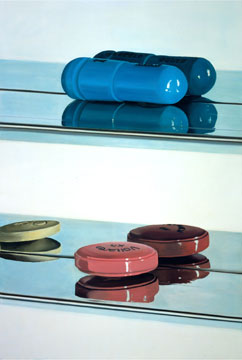
Could he function simply as the ultimate British establishment figure after all, with a mix of style and literary pretensions going back at least to Thomas Gainsborough? Consider the same artist five years apart. In one exhibition, he re-opens a huge Chelsea gallery with half a dozen rooms of fish tanks and Ping-Pong balls. Five years later, he returns to painting, as a commentary on society and mortality—and a postscript seven years later still finds "The Complete Dot Paintings." Which stands for Damien Hirst? One may not be able to tell them apart after all.
The doctor is really in
Hirst has always played with the very idea of raw art while wallowing in Britain's traditions of high seriousness going back to William Blake quite as much as a paradoxical conservative in new media like Tacita Dean in films of artists. As one entered Gagosian's fashionable new Chelsea space for his 2000 exhibition, one saw a huge anatomical model—male, of course—called Hymn. Hey, man, get it?? If the nudge sounds silly, that, no doubt, is the point. Hirst loves playing games about art-world games. When, a few years later, he may have had his own London exhibition taken out with the trash, convincing the press that the janitor had made a mistake, had he added to one's cynicism about art—or merely about him?
The rest of the show makes the artist into a member of the medical profession, like a bad parody of art therapy. Pills, knives, dead bodies on stretchers, skeletons—Hirst surrounds them all with the detritus of long days and nights, from newspapers and cigarettes to, all to often, his signature vitrines. A balloon floats precariously over surgical knives. Elsewhere, the magic trick of air suspension gives a skeleton Ping-Pong balls as moving eyes. Still elsewhere, one could stare at nothing more than two vitrines of those balls scattering in the moving air.
Hirst makes a doctor's daily dealing with death a part of the carnival—the same art-world carnival that delights and disturbs in the hands of others from Yoko Ono and Nam-June Paik to Pipilotti Rist. In the same breath, he tosses off associations with eighteenth- or nineteenth-century cabinets of wonders, the movies' cabinets of horror, the banal domesticity of fish tanks, and the pious glass cases of contemporary art museums. Vitrines also recall his own dead cows, as if the circus animals have deserted him, leaving behind only the fame. He piles metaphor upon metaphor for the ways one tunes out the terror in day-to-day life. He evokes the artist, peeling back layers and piling on cow dung to get ever more raw, all the while caught up in the entertainment business.
For some, art keeps alive the comforts of the active imagination and a place to call home. For others, it means the rawness of discovery. Paradoxically, Hirst confront viewers with their numbness and yet insists on inducing it. Gallery-goers crouch in long contemplation of the Ping-Pong balls, as if no sense of meaning or fresh experience could tear them away. I stumbled into the party exhausted and sweaty from a jog by the Chelsea Piers, the perfect yuppie but without the cash, and I fit right in.
I know no artist more glib—and more ready to market himself for auction at Sotheby's. By now, not even Anish Kapoor challenges his visibility when it comes to British sculpture. He also has the brains to pick up the obsessions of not just Warhol but also Paul Thek with his own raw meat in glass cases. Yet I know few with more stupid throwaways than his paintings based on color charts and color wheels.
Hirst has one saving virtue: I know few, too, so conscious of how the art's weakness annoys me—and so prepared intellectually to incorporate it into the work. I want something less smug than that, too, but can he maintain at least that sensible start? Look again five years after the carnival, and step into legitimate theater. Unfortunately, Hirst himself gets to treat it as high tragedy.
Swallowing the pill
For some hard-core fans, Hirst's most impressive new work comes in a long back room, at Gagosian once again for 2005. Over several panels, a woman deteriorates before one's eyes, from reasonably pretty to haggard to seemingly close to death. The ambition of a work over several frames certainly contributes to its impression. So does the harrowing theme, reportedly a portrait of cocaine abuse, and, conversely, the comforting high ground of its moral. So does perhaps the biggest shock of all: Hirst is painting again.
No, really painting this time, give or take a passel of uncredited assistants. Of course, he has turned out canvases before, hundreds of them, like the pair in the UBS collection concurrently at the Modern. Formerly, however, he let abstraction take care of itself, less as process painting for the masses, like graffiti for Rudolf Stingel, than as an artifact of a highly exclusive party. Friends laid their colored dot down for him or helped spin out splashy circles. Now he has taken on English painting's sacred ground, realism. My English friends would be appalled.
It sounds more of a change than it is. For one thing, as the UBS context suggests, he was always aiming for ubiquity, if not eternity. One can think of his midlife crisis in paint as one more play for artistic status, right up there with recent installations such as Mortuary, which offered up its own pretend chills. For another, Hirst's casual but more or less competent realism reflects the same calibrated mix of cavalier, shocking, and terribly well intentioned. (Do say terribly with the right accent.) Like the preserved specimens that made him famous, they get under one's skin quickly, risk boring one soon after, and then earn respect or, more likely, consternation as one realizes that he means ever so seriously to grapple with mortality.
Here, too, one feels first the cheap thrill and a genuine physical revulsion, before still less fortunate feelings intrude. Images include medicine cabinets, chilly hospital settings, and needles under the skin. I suspect he intends the ambiguity, in what could represent either controlled substances or ordinary medical practices, to evoke the shock of transgression and the dread viewers may feel confronted with their likely future. Along with the usual games with the status of art, Hirst also remains a recycler of 1980s' Neo-Pop, even if it recycled Andy Warhol and others who themselves recycled Dada, which in turn would happily have appropriated the Young British Artists given the chance. Only this time Hirst is recycling Eric Fischl instead of Jeff Koons. He must love that his show hangs almost adjacent to Mary Boone's gallery—and that Boone happened to be exhibiting Fischl.
As usual, Hirst's shocks quickly become trite and trivial, his serious aims approach the stale or pretentious, and his ambiguity come near to meaning nothing much at all. Perhaps the woman does bring home the effects of cocaine, but you knew all about that, probably when it reached epidemic proportions way back in Koons's heyday. Besides, one had a whole show about the East Village this winter to think it over. In reality, however, you must take the gallery's word for what the work shows, especially given Hirst's limited skills as a realist. The panels might represent different women, or they might represent pretty much any generic ailment. I prefer to think of it as Lucian Freud disease.
It does not help for me that representing his own medical imagery on canvas cannot by itself add a layer of self-reflection. It does not help either that Hirst brings his serious concern not just to a truly silly statue—at the Lever House in midtown—of a pregnant girl, her innards exposed to anyone in need of another anatomy lesson—but to prose as well. As for his poetry, on sale at the desk, it offers duly ponderous pronouncements about "withering . . . truth." Hmm. I bet the neat rows of colored pills allude to those dot paintings after all.
In his dotage
Hirst may not know much about painting, but he sure knows how to get people talking. With more than three hundred dot paintings spanning all eleven branches of Gagosian to greet 2012, it is as if the art world's largest chain store had appeared out of nowhere. With colored circles on a white field, each color planned and executed entirely by assistants, not a hint of deeper meanings or deeper intentions can get in the way of talk. With a title like "The Complete Dot Paintings" and a promise that, for five weeks, "the sun never sets" on his art, Hirst already shows his skill at branding. If the first is off (by a factor of five), and the second is off (by a matter of the Pacific Ocean), that only adds to the delight in hype itself. The talk may run to excitement or to dismay, but it is still talk.
Reviews run to both at once, give or take the lonely gatekeepers of Western civilization, about whom the less said the better. Critics duly note the hype and blandness, before moving quickly and downright ingeniously to the defense. One notes that plenty of museum artists lack the profundity of a Rembrandt. Another compares the walls of color and the use of assistants to Sol LeWitt—while another argues that, when it comes to "visual interest," Hirst could have done worse, like Christo with The Gates. Besides, the critic adds, if the dots display "unevenness," and most are just plain "very bad," one can always pick and choose. The Web has run much the same course as the pros, from questioning whether proper art can rely on assistants to the largest outpouring of Facebook links and images that I have ever seen.
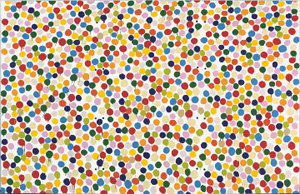 The defenses hardly bother to describe the work, but one can see why. It is not easy to know what to praise or to condemn when so little is going on, deliberately so at that. Sure, one can move between paintings as large as Abstract Expressionist murals to as small as miniatures—or from circular designs almost like Op Art to a few bare circles more than a meter apiece, like Minimalism. One can move from a big room on 22nd Street, to arrangements by series on 24th Street, to several floors uptown that give one the flattering sense of penetrating more and more exclusive spaces. But connoisseurship is beside the point, just as with more politically savvy dot paintings by Sarah Morris. Everyone will have favorites, because there is no accounting for taste, and because the human brain always finds patterns in randomness.
The defenses are not only excuses, but lame ones at that. Finding Hirst better than artists one dislikes does not help, and Christo deserves better anyway, even past his prime. Yes, Central Park outshines his glossy orange—just as the American West looks more than glorious enough without his wonderful Valley Curtain (or indeed apart from Robert Smithson's Spiral Jetty)—but so what? The rippling gates and curtains draw on the visual splendor of their surroundings, and the combination creates a collaborative work beyond Hirst's wildest dreams. As for LeWitt, he manages to derive chaotic outcomes from strict directions, while Hirst derives predictable outcomes from lack of direction. LeWitt also somehow spins artistic control into an assault on the whole idea of authenticity, while Hirst steps away from the canvas to play the star.
The criticism is just as misleading. Workshops sustained art history, at least until Michelangelo banished assistants from the Sistine Chapel, and an artist can turn to them today, too, exactly as the task demands it. And filling eleven galleries on three continents demands it if anything does. Many struggling painters resent overblown success in place of the handmade, but tough. For all that, though, the outrage raises a troubling point. The end of the workshop system coincided with the increasing status of art—and here an artist is hiring assistants in order to play genius!
As with so much else, the turning point comes with Andy Warhol. With the Factory, Andy Warhol genuinely hoped to democratize art, but he also relished Warhol's roles as stylist and celebrity. Hirst has his own artistic ambivalence. His rotting flesh and shark tank shared the earnest meditation on death in Brits like Francis Bacon—while boasting of ease and excess. Hirst took up painting before, as a realist, and he failed (although his cabinets of pills do look like spots). Ironically, the dots allow him at last to bring his self-confidence to painting, and one may as well enjoy the excess.

Damien Hirst filled the Gagosian downtown space through December 16, 2000, and again through April 16, 2005, and then February 18, 2012. In a separate review, I also caught his opening in London in 2003, with a new gallery site he apparently hated. Oh, and yes, Hirst did execute at least a couple of the earliest dot paintings by hand.