
|

|

|

|

|
Who Gets to Make Attributions?
John Haberin New York City
Maryalice Huggins: Aesop's Mirror
Young Archer and Michelangelo
"What stayed with me was the memory of the way things look as time passes through them." Maryalice Huggins loves antiques, and she is lucky enough to surround herself with what she loves. She has worked as a restorer and then consultant to collectors. Along the way, she became one herself. She acquired, as her wry title has it, Aesop's mirror.
Along the way, she found herself in more stories than she could have imagined. They span past and present owners, but also the mystery of mirror's origins. Establishing that proves surprisingly hard—for all the love and trust it inspires in her. It also proves a fascinating story in who gets to play expert and who decides. 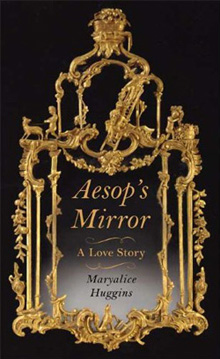
Huggins's dilemma may sound as arcane as a bit of Americana. In fact, it has resonance not just for her, but for anyone who has noticed something: suddenly, art and attributions are making the headlines. Every time one looks, a museum finds another Vermeer, another Leonardo, or another Michelangelo. Why all at once, and why now? And why so fast, just when someone like Huggins still takes years to authenticate even a mirror? Together with Young Archer, on display at the Met as a young Michelangelo, Huggins's experts offer an object lesson in art and the politics of authenticity.
Related articles look more in depth and what goes into an attribution, with Vermeer as a test case, and why art takes words and not just looking. Another spends more time with yet another much-hyped and questionable young Michelangelo. What distinguishes it from his, I ask there, and how does that help in understanding his art—as well as the generations before and after? Here I shall focus more on the people, power, and institutions behind it all, along with the love.
Gold leaf and sour grapes
Huggins describes the life of old furniture as changes in the lives of herself and others. Her title, Aesop's Mirror: A Love Story, already sets the tone. Always the good sport, she speaks of attending an auction in Rhode Island as a favor to a friend. Sure enough, she cannot resist what she cannot afford, a mirror framed with Aesop's "The Fox and the Grapes." And then she just has to buy a couple more pieces, including a preposterously Neoclassical sofa. Talk about fables of overreach.
Still, why not splurge? She made sure that her purchases had the proper authentication. And thereby hangs a tale, in a genre somewhere between a personal history and a mystery story. As part of its pleasure, the book offers plenty of help along the way, but Huggins never quite obtains closure. Not that she really needs it. "Analysts' couches are usually modern," she notes, and "not my taste."
Time passes though things—and not just in the sense of placing them in the past. They also take on a past in the hands of others, and art's materials age as well. All that gives Huggins plenty to explain, and she is fully up to the task. She covers period styles and artists, the meaning (or "iconography") of the carvings, their documentation, possible owners and their fates, changing markets and attributions, techniques of restoration, and the age-old attraction of a mirror images. At first chapters alternate between her native New England story and the expertise of others, but the two spill into one another in no time. As she says on the very first page, "The question of an antique's value is tough to answer," which is to say that no one definitively can.
"It is not like the Blue Book value of a car, although the sale price is based on similar criteria: model, year, and condition." The carvings closely follow Thomas Johnson in eighteenth-century London, but with American wood. That could make the mirror an early American original or a late Romantic imitation. Rarity raises value, but uniqueness calls an object's authenticity into question. As neither an outsider to the art world nor a professional appraiser, Huggins gets more than her share of advice and frustration. Pretty much everyone condescends to her, from a quick-witted local auctioneer to smug museum professionals, and pretty much everyone experiences what she terms "seller's remorse."
To say that their stories are footnotes to art history is not at all to disparage them. History as seen through ordinary lives has become more and more the norm, and besides it is her life, too. Huggins goes wrong, in fact, when it no longer is, as she shifts halfway through to the generation after the mirror's commission. Like an Edith Wharton novel on overdrive, these chapters involve Americans stranded in Europe, marital woes, and an Irish patriot. In the process, the mirror and its mystery are left behind. It is a compliment to her that one misses them.
Art these days may seem to live and die entirely in the present, a time of emerging artists and short memories. Still, in an era of installations and performance art, time once again flows through art objects. Amid all the hype and cynicism, one can forget that artists and dealers care so much about what they do. Huggins may be "living in the wrong century," but she remembers. For her, antiques never once become mere collectibles. As her subtitle says, a mirror is a love story.
Art history with balls
Huggins exudes modesty, the joy of inquiry, and love. And whatever else one can say about James David Draper, he has balls. It takes at least that to claim yet another work for Michelangelo as a boy, much less one not mentioned by contemporaries, who would have died to latch onto another work. A newly acquired marble, Draper says, shows Michelangelo's "daring promise as a fifteen- or sixteen-year old." All it took to convince him was a short walk and better lighting. Now, as will appear, the question is whether the sculpture, too, has balls—or at least realistic ones.
A curator, Draper has thrown the museum's weight behind Young Archer only weeks after The Torment of Saint Anthony left for the Kimbell Art Museum in Forth Worth. Michelangelo, says the Met, painted that one at age twelve. In between, the Getty snared a woman in profile, long considered a nineteenth-century German painting, as a Leonardo and Leonardo's Saint Jerome. Like the profile portrait, the marble nude did not take digging. Both surfaced decades ago, when historians universally dismissed them. The sculpture has stood since 1952 in plain sight, hardly a block away from the Met, in an embassy lobby.
I have had my say about Saint Anthony, and others have already pounced on the latest claim. Criticism centers on the archer's vacuous beauty, flat face, flaccid anatomy, long belly, coyly arched back in place of the firm Renaissance quarter turn known as contrapposto, curly hair tacked on almost like a wig, and a decorative, claw-shaped quiver far more polished than the archer himself. One could also find flash points more specific to the young Michelangelo, who lingered over the psychological and physics tensions in sculpture by Donatello or Nicola Pisano's The Damned. In perhaps his first certain work, Madonna of the Steps, Mary seems to preside in stark profile over a funeral. But I defer instead today to a further complaint, from the blog CultureGrrl. As her anonymous source says, the boy's unfinished testicles descend to almost exactly the same height.
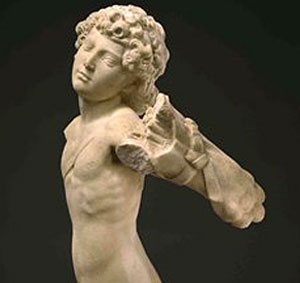 Every so often, someone reminds me why I shall never be the world's most famous arts blogger. I write at length, I nurse things forever, I do not take pictures on opening night, I do not have anonymous sources, and I have no ear for gossip. I knew that all along, but now I feel especially ashamed: my blog lacks sex appeal. Besides, I do not know certain points of male anatomy well enough. I had better check myself in the mirror when I get home.
Grateful as I am for CutureGrrl's skepticism, I wonder about the naughty bits. I trust that she has made a personal study of male private parts in Renaissance sculpture—or Italian men. (To my eyes, even Michelangelo's David looks quite symmetrical between his legs.) Just as important, attribution does not simply turn on quality, especially not for a teenager. One line of hers, though, did leap out at me. She links to a 1996 New York Times article backing the attribution.
John Russell, then the paper's head critic, has a discernment and knowledge of history rare in day-to-day arts writing. Yet he also has a weakness—the ability to accommodate almost anything. Here he found an ally in Kathleen Weil-Garris Brandt of NYU, who takes the sculpture's very oddities as proof. Why, she asks, would someone faking a Michelangelo added something as quirky as the hair and quiver? The question gets at what it means to make an attribution. It is not simply about quality, originality, or uniqueness, but about reconstructing an artist's life, work, and world.
The politics of authenticity
As I tried to explain with a possible Vermeer, that takes looking—at style, imagery, technique, influences, and documentary evidence. When Brandt points to quirks, she is pointing to art that values personal touches and decorative finish more than anatomy, formal simplicity, or a sculpture's inner life. And those are precisely the values of at least a decade after Michelangelo's youth. True, if the quiver were shaped after the Batmobile or a rubber mask of Ronald Reagan, it could not be a fake Michelangelo, because a faker would never make such wild additions. But skeptics are not calling this a fake Michelangelo. They are saying that it is irrelevant to Michelangelo.
That should be obvious enough, but it raises even more questions. Why the newfound gullibility—and the excitement? How did obscure period pieces from Mannerism become models for the birth of High Renaissance? Of course, attributions to a teenager fill in gaps in a known artist's career, and that makes them harder to disprove. Still, why so much about Michelangelo, and why now? How did so much of art history suddenly come to center on a legend?
If the display at the Met shows one thing, it is how much has changed in the century since the sculpture's discovery. Traditionally, connoisseurs like Pierre-Jean Mariette in the Baroque formed a private men's club, devoted to keeping people out. The twentieth century raised the bar in other ways—by adding historical knowledge, theoretical sophistication, and a scientific ethos. All that meant downgrading more and more work, from "old master" to workshop. That high bar still holds on the auction market, as seen in Aesop's Mirror. Huggins fights every stop of the way to authenticate that mirror after an estate sale, and every expert she meets looks for reasons to reduce its value.
What has changed? How can museums now be rushing to attribute things to a handful of artists? Not all that long ago, the Met gave to Caravaggio a painting that few historians even bother to dismiss, and it has also upgraded a possible Velázquez portrait. How can the museum display triumphs like these without a hint of doubt or controversy? It all comes down to an old saying: follow the money.
Money helps explain why most dealers and auction houses are, rightly, tough customers. No one wants to be stuck with something worth a fraction of its price. A top museum, however, faces quite the opposite financial pressures. As the public for art has grown, big names translate into blockbuster crowds, gift-shop sales, and curatorial careers. As the public has grown, too, it includes more people who do not recognize many names beyond Michelangelo. Meanwhile, unlike almost any private dealer I can name, the Met has the clout to change perceptions.
When the Met responds to rising prices with speculative claims, it plays on the gap between big players and small ones. If that sounds familiar, it describes a speculative bubble, and maybe the Met can keep this one from bursting. Still, as a wider public comes to follow discoveries like this, more people may come to care about the artist and what goes into the work. They may even come to value lesser names and changing styles. Or they may discover art after Modernism, with all the pleasure of appropriation from the past and all the distrust of authenticity. One way or other, better art history and better contemporary art will take balls.

Aesop's Mirror: A Love Story by Maryalice Huggins was published in November 2009 by Farrar, Straus and Giroux. "The Young Archer" went on display at The Metropolitan Museum of Art at that time as the start of a ten-year loan. CultureGrrl posted November 2.