|
|
|

|

|
Time Is on Their Side
John Haberin New York City
Christian Marclay: The Clock
Leslie Thornton and Stephen Vitiello
"What, then, is time? If no one ask of me, I know; if I wish to explain to him who asks, I know not." The confession, from Saint Augustine, has not lost its enigma. Perhaps he should have asked an artist.
Plato (who wrote artfully while hating art) saw time as the nature of being—a mere human's falling off from the eternal. His time sounds like action painting or performance art. Kant saw time as a given, in the structure of consciousness. In other words, he is ever the formalist. For still other philosophies, time is an illusion. Call it video art or the movies. 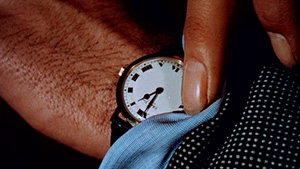
It's the moment of truth. . . . It's my first time. . . . It's time to rock and roll. . . . Those and countless other moments have passed into film history. Now, too, they have passed into a remarkable video, made up entirely of excerpts from the movies. It is a tribute to film, appropriation, new media, raw experience, simulation, and a great dealer's commitment after so many years to art.
Christian Marclay calls that video The Clock, while Leslie Thornton uses video to locate some disturbing biological rhythms. As an artist who has built on music, Marclay should know rhythm well, and he does. Meanwhile Stephen Vitiello watches a now-legendary skyscraper as time passes. In his homage to New York City on the High Line, he also listens to bells toll the hour. Marclay is also the topic of a recent Whitney retrospective. And recent earthworks and performance by Terence Koh and others capture yet another sense of time as well.)
Still time
The Clock lasts a full twenty-four hours but runs continuously, and Paula Cooper stayed open Fridays through the wee hours of Saturday morning to accommodate it. Again and again, for as little as a fraction of a second, it cuts to a clock face or to dialogue about the time. You can set your watch by it, and I did. Christian Marclay ricochets past iconic images of time, from the Houses of Parliament to Big Ben and from train stations to airports, but also past the iconic faces of the movies. I cannot begin to calculate how many, nor the research and ingenuity behind them. It only adds to their mystique if they seem to belong to a single unfolding pageant—and if one cannot quite pin them down.
So many experimental films from the 1960s took place in the present tense, although Michael Snow uses more cuts in Wavelength than I often remember. Films by Joan Jonas, Mary Miss, Nathalie Djurberg, and Carolee Schneemann, too, played with time. Coming right after Pop Art, they moved slowly or even invisibly, as a lesson in attention and patience, much like the deliberate movements of an escaping prisoner of the Nazis in Robert Bresson's A Man Escaped or a Manhattan rush hour for James Nares. Andy Warhol actually drew out time, by projecting his films at an older, slower speed. Marclay, in contrast, has created an epic, but an epic of daily life, in real time. But that real time unfolds in the past, as a Hollywood fiction.
It is mesmerizing, like the play of time in music for Anri Sala, but it does not exactly reward patience. Every moment is a moment of urgency—the hordes waiting for a bank to open in the panic of the Depression, kids rushing out of the classroom as a teacher cautions them not to run, a woman who will not pay for pizza past its time, a fight over late afternoon tea, a rush home after work to trim the tree, men and women hurrying to meet or to escape from something unstated and unseen. I'm late. . . . You're late. . . . Too late. . . . And each moment promises a resolution that the video withholds, by cutting to something else.
People may try to stop time, by hanging for sheer life on the hands or by smashing clocks for their ominous ticking and tolling. They can try to keep up by punching the clock, like Charlie Chaplin in, naturally, Modern Times. Not every clip clearly indicates a time, as with the man coming back to get his watch, a jewelry store heist, or a passing truck with Time in its logo. And not every clip that does has to do so to matter, like the shot of the Salvation Army with its greeting or warning, There Is Still Time. Regardless, the crucial moment is always coming and always here, even when Peter Fonda in Easy Rider shows his disdain by casting his watch in the dirt. Dennis Hopper still cuts to a close-up of the time.
On my first visit one afternoon, I had to think. How much of the frantic pace belongs to Marclay's edits, how much to the movies, and how much to the actual time of day? One may take breakfast late, at eleven, only hurry up. Would others linger in late afternoon sunlight, long evening solitude, or late morning sleeping in? Maybe, but Marclay's laid-back career already contrasts with film convention. His usual mix of visual and sound art encourages improvisation, participation, and spontaneity.
That contrast, however, overlooks something else: how much of the expectation, anticipation, or dread belongs to the viewer? Marclay is merely sampling, just as with his "turntablism," and the viewer can come and go at will. Only a madman or a critic would sit through all twenty-four hours—and then only as a stunt that could never equal Marclay's own. Like the man returning home from work to a perfect life, he may find his own world an obsessive fiction. And in time The Clock starts to feel like an actual movie, helped out by sly editing, sound that may spill into the next visual, and film's shortage of imagination.
Binocular vision
Cuts are, after all, the language of film editing, and Marclay's are strangely seamless between faces, between parallel plots, between different eras, or between color and black and white. Time here may not stand still, but space and place do. And then evening arrives, darkness falls, and our fears come out. Conversely, one becomes aware of Marclay's departures from real time, including narrative time, as he compresses or extends the moment to make the quotes work. If enough movies hang onto the seconds before midnight, he will just have to return to that moment a few times to catch up. Time is on his side.
I could say more, but how much time do I have? I returned half a dozen times for varying durations and varying times of day. I could not resist the installation's couches, and I could not resist wanting to see what happens at the stroke of noon. (But no, I did not stay overnight.) I could never encompass it all anyway in a review. I had no choice but to see it, several times, before it closed—and better not be late.
Leslie Thornton calls her latest videos "Binocular," but she has a singular vision. She has pursued wildlife globally, although often with the convenience of zoos in California and Florida. She gets up close to creatures, as individuals but also in their habitats, from a slim branch to a bed of leaves. The result is a kind of textbook in animal behavior, except that it moves. Indeed, much of its fascination lies in how slowly and surely it moves.
It is singular, too, in its sense of nature—as something calm, determined, and inescapable. She does not focus on welcoming species in her choice of black birds, bees, and more often than not snakes. She did after all call a previous project, in "Greater New York" at P.S. 1, Peggy and Fred in Hell, and her father worked on the Manhattan Project. The videos feel more fascinating than threatening all the same, much like her view of an amusement park in a more high-tech exhibition, "New Order." Perhaps it comes with the birds and the bees, the flowers and the trees. The motion of a swarm or a cobra is downright reassuring, and that of a parrot's head and beak is most patient of all.
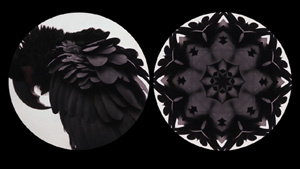 They are also singular in the sense of a formula, the inspiration for the title. In each case, she pairs the shot at left with a second circle at right against the same black ground. The second translates animal behavior into symmetric patterns by giving a part of the image multiple reflections. The folds intensify both color and the contrast between the colors and the black. The naturalism already approaches abstraction anyway. I stared for some time at an eyeball shape without realizing that it was another snake.
This singularity does not sound promising, and in fact the photographs by the entrance make clear their limitations. Sure, natural history is cute, like Chelsea's own Nature Channel, and (duh) an image folded onto itself looks like a kaleidoscope. However, the sense of child's play vanishes in the dark with the videos. The patterns and their multiplicity bring out how each behavior has a rhythm of its own. Perhaps her experimental films have always been about confronting her fears, much as for Janet Biggs in the Horn of Africa, by finding in them the pace of life.
The tolling of the bells
I worked on the eighty-eighth floor of the World Trade Center, and I never saw the sun set or heard the balls chime. We were not heroes, and it was not sacred ground. It was not even a window on the world. It was 1976, and the Twin Towers then were still unfinished. For me, they were also thoroughly unimaginative architecture—and a job. And I loved every minute of it, not for itself, but as a respite from real life.
My job was boring and clerical, for a Wall Street firm. Back then, someone still had to check each mis-entered trade against the slips of paper that had littered the floor of the exchange. I had given up on my degree halfway through senior year, without finishing a thesis or even finding an advisor in a brutally competitive major. Yet it was the bicentennial year, and I took pride each morning at rising so high, as if New York were still the capital of America. The routine itself was an escape from despair, and the sheer silence of the city below created a comfort zone. Someone else, someone not a temp, must have had a window on the world, but not I.
Stephen Vitiello did, but it has taken him some time to come to terms with it, and I am not at all certain that he has. In 1999 he had a space on a higher floor than mine, in the other tower as it happens, as an artist in residence. More than ten years later, as if waiting for the wounds to heal and Deutsche Bank to come down, one can see the results. The program called the studio a WorldViews residency, and he took it at its word. One simply looks out toward New Jersey as a strong afternoon sun gives way to sunset and artificial light. Commuter ferries move in insistent diagonals without announcing their destinations.
Vitiello's video is silent, but "the first sound that I ever heard through my contact microphones," he writes, "was church bells coming from somewhere in the distance." That in turn inspired A Bell for Every Minute, his extended installation along with that of Sarah Sze on the High Line. Each minute one chime resonates in the relative enclosure of an overpass and dies away, from Vitiello's recordings throughout the city. It makes up for what it lacked in drama on the hour, when the sounds come together as a kind of idealization of church bells. No doubt the contrast is part of the work, along with the sensation of all of New York in one place, like the model city at the Queens Museum. The first time I looked for it last summer, I actually walked right by it.
Vitiello's show has preparation for that work as well—in what falls somewhere between art as music, music as sculpture, random noise, and a dull roar. Both video and sound art, as for John Cage and "The Musical Brain," encourage rest and contemplation rather than the wrenching memories of Poe's "The Bells," although Rafael Lozano-Hemmer's Voice Tunnel does take a bit of a walk. It is hard not to settle in for the duration and to hum along. One can see both works as measures of time. I cannot help thinking, though, of both, too, as works in progress. They are also oddly distancing.
In Vitiello's hands, the New Jersey skyline seems like New York without its landmarks, from an unfamiliar angle that no longer exists. Compared to Warhol's Empire, his video seems deliberately less iconic and more than slightly derivative. As if to emphasize the project's unfinished state, the artist's equipment slips into the frame without ever quite signaling self-reflection. Maybe it is about to find its way after twelve years. By the summer, my supervisor at tower 2 offered me a permanent job, but I had to move on myself. I had to cross not just the Hudson but America and back, before finally getting my degree.

Christian Marclay's "The Clock" ran at Paula Cooper through February 19, 2011, "Modern Women: Single Channel" at P.S. 1 through May 2, Leslie Thornton at Winkleman through February 5, and Stephen Vitiello at Museum 52 through February 12, with his High Line installation continuing through June. A related review looks at Marclay's sound art.