|

|

|

|

|
Painting as Extreme Sport
John Haberin New York City
J. M. W. Turner
J. M. W. Turner was in his forties in 1818, when he invited a patron's oldest son to watch him paint:
He began by pouring wet paint onto the paper till it was saturated, he tore, he scratched, he scrubbed at it in a kind of frenzy and the whole thing was chaos—but gradually and as if by magic the lovely ship, with all its exquisite minutia, came into being and by luncheon time the drawing was taken down in triumph.
Was he the first action painter? Yes and no. And maybe yes again. For Turner, painting was pure impulse, but his first impulse was minute observation. And yet as consummate observer, this painter was very much part of the action. 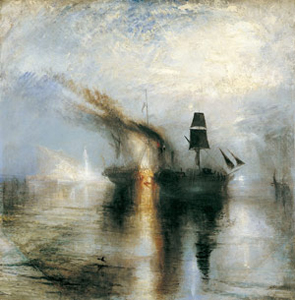
Turner's retrospective favors titanic struggles with nature, myth, and history. Yet it includes plenty of works on paper, starting with a cathedral beneath uncanny crisp, blue skies. After that, the Met pauses here and there for a room of watercolors. (They stood in more intimate rooms off to the side at the National Gallery in Washington, and I did not see their second stop, in Dallas.)
But do these studies show increasingly abstract experiments—or rather tireless preparation? In this gradual, exquisite frenzy, an impulse could take years and carry the artist across Europe. In a related review, I ask how reviews of Turner, a hero in the age of Abstract Expressionism, now relegate him to an academic past.
Improvisation or performance?
The words of a fifteen-year-old boy convey all the fluidity and excitement of Turner's Romanticism, right down to the British punctuation. They also raise serious questions. For starters, did the event happen? The account survives only from the hand of another. It belonged to the daughter-in-law of the witness's younger brother (got all that?), herself not born until 1836. Does the manuscript get it right?
Turner thrived on paper, from a self-portrait sketch at fifteen, as commanding and baby-faced as a young William Wordsworth. Born in 1775, he exhibited in his father's barbershop window at age thirteen, enrolled in the Royal Academy school a year later, exhibited his first watercolor at the Academy at fifteen, and became a full member in record time. A portrait in oil at age nineteen shows a lean, almost anxious artist—well dressed but open collar, baby fat gone, eyes wide open, his body ready for action. And watercolor and pen stimulated his art throughout his life, from the architectural studies that first brought him fame. As for oil on paper, he hardly touched it.
Could Turner have chosen a witness too inexperienced to betray his trade secrets? Could memory and time have corrupted the rest? Could the very notions of chaos and minutia reflect a boy companion's wonder and adoration? What he described as chaos, critics called crude and coarse, and they did not mean it as a compliment. Could the artist have staged the whole thing to answer his critics, right down to the triumphant ending?
"Action painting" has a messy history, no doubt awaiting its historian. Cave paintings incorporated the accidents of pigment rubbed across ridged surfaces, almost like the rubbings across found objects that Max Ernst called frottage, and legends about thrown sponge marks as an impetus for painting date to ancient Greece. Abstract Expressionism depends in part on the image of artist as expressive genius and shaman that Romanticism did so much to nurture. However, Modernism changed the rules, too, and it does no good to read later prejudices into the past. Jackson Pollock had the benefit of Cubism's fragments of perception, Dada's trust in chance, Surrealism's in dreams, a fashion for Jung, the passage from American folk art to drip painting in work by Janet Sobel, and Lee Krasner to keep him sober. Anyone expecting the same from Turner will wonder at his yellow paint and historical pageantry.
One thing is certain: Turner was performing. He understood painting as a performance, of a kind that Abstract Expressionism never knew. It starts with the subject of his narrative paintings, much as for a pre-Romantic like Jean-Baptiste Greuze. When he depicts nature's cataclysmic power, Hannibal invading Italy, a pilgrim's dangerous mountain crossing, or England's triumph over Napoleon, he is creating a moral theater—and it is not entirely coincidence that I post this on an anniversary of 9/11. When he places himself within the scene, as the observer with risks of his own, he inserts himself into exactly that.
He took his sketchbooks on decades of travel. He anticipated an Impressionist's intensity of color and belief in painting on the spot. Does that sound ever so down to earth? Maybe, but he picked some wild spots. The origins of Impressionism bridged nature and culture by taking a location in between, the Paris suburbs. The Londoner bridged them instead by going to extremes. Turner treated painting as an extreme sport.
The visionary and the doer
The retrospective goes lightly on the precocious careerist and downplays his portraiture, but it gives him a very fair shake. It picks him up in his twenties and leans heavily on the Tate's collection, as it must. From there, a largely thematic arrangement does not have to play fast and loose with chronology. The artist's subject keeps changing because he goes in search of it.
Whereas Pollock appears at work in photographs and on film, Turner did not let others into his studio. Instead, he finished paintings in long "varnishing days" at the Academy, like a crowded opening today without the cheap wine. In this way, he could reserve glimpses of his process for calculated public moments—more stagecraft than improvisation. As the modern saying goes, "you had to be there," but only the artist and a chosen public had the good seats. Pollock's drips identify the painting with its process. Turner's thick, rapidly labored surfaces record his working his way out of accident and into history.
His roots in architectural painting must have made his later free style appear as a double betrayal. Already, though, he is taking liberties. In his early watercolors, pen lines connect the surrounding vegetation to bare, ruined choirs. In the dark sheen of a night Turner seascape, moonlight carves storm clouds into another kind of cathedral vault. The same central arc turns up repeatedly in his paintings. Where the masses of landscape and human habitation have a strong asymmetry, with its own onrush into depth, nature's temple unifies and presides over the whole.
Moonlight and religious symbolism parallel those of Caspar David Friedrich, born just a year before him. When Turner takes to the Swiss Alps for the Devil's Bridge, he again has something in common with Friedrich's allegories in the wilderness. However, he goes much more lightly on the allegory and more explicitly on the observed wilderness. From the bridge crossing, one has no doubt where in the mountain pass Turner stood. His point of view also reduces Friedrich's tiny figures to a more fragile humanity than the German's monks and moon watchers. Where the German artist creates outsize heroes, Turner subordinates his cast of characters to the painter's eye.
Before long, Turner is burnishing his academic credentials with classical scenes. Modern eyes may prefer the humbler realities of another great English Romantic, John Constable. With his river coursing through locks and his cloud studies, Constable ties himself to a time and place—one, unlike Turner's London or the Great Western Railway of his Rain, Steam, Speed, becoming safely a part of the past. Still, as student of architecture and painting, Turner does his own tour of England, and Constable's Salisbury Cathedral reflects the same active observer of a spiritualized reality. They connect the artist as visionary to his investment in his vision.
These artists make Romanticism a matter of more than dramatic subjects and distant longings. Like the Enlightenment painting before them, they also reflected a new empiricism, but not only that. For J.-S. Chardin, ordinary things had unprecedented solidity and unprecedented transience—a cat leaping across a ledge, an ashen smear of oil on a ceramic jug. The Romantic imagination, in contrast, is very much part of the construction of its vision. Uniquely for Turner, the active imagination takes some serious physical activity as well. Turner can show Hannibal crossing the Alps only because he has, too.
Catastrophe as siren
Luckily for the artist, his fellow mortals quickly conspired with his vision. Just when Turner was seeking the scale of history painting, Europe staged the Napoleonic wars, with his nation as the victors. Just when he looked to the sky for an uncanny mix of nature and culture, his native city obliged: sunlight dissolved in the same polluted, smog-drenched skies that would soon appall and delight Charles Dickens. Just when he needed still brighter lights and a more skeptical view of the course of empire, he plopped down in Venice. Just when he got old enough for a little fire and brimstone, the houses of Parliament caught fire.
Even at his slickest, Turner followed the action each step of the way. He saw Admiral Lord Nelson's victory and death at Trafalgar, and he painted the sea battle "as seen from the mizzen starboard shrouds of the Victory." Crossing the Channel, he visited the field of battle at Waterloo. He was in London for the burning of Parliament. Raised in Covent Garden, he might have called the conflagration home.
None of this prevents him from aspiring to the traditions of history painting—or just making things up. One can see him as halfway between Constable's country labor and Friedrich's spiritual gloss. That simply makes him a Romantic, but it may have something to do with his personality and aspirations. He had a working-class upbringing and an unstable, possibly psychotic mother. When, late in life, he paints castles and estates as strangely isolated and drenched in color, he could be lifting them above his settings. He could also be conveying his own alienation and proximity to suffering.
One can see past the heroics even in battle. Limbs appear limp, and eyes stare out. The paintings of Carthage and of modern Venice also prefigure The Course of Empire, as seen in American Romanticism. These things, like the abstraction and excesses, added to the hostile criticism: why could he not paint people and landscapes with a little more dignity and coherence? Why drown them in industrial pollution and a hostile sun?
The same extravagance endeared him to his greatest champion, John Ruskin. It also brought him new defenders in the twentieth century. In the light of abstraction or the all-over haze of late Claude Monet and his Water Lilies, his paintings display a steady progression to saturated canvases left unfinished at his death in 1851—some after nearly a decade of effort. Horses in a near-empty landscape seem to have melted in a hot sun and a final cataclysm. For all that, the prosaic moments keep appearing, lending the late work its richest colors and most contemporary feel. Black returns in paintings of commercial shipping, and smoke hangs down with the mournful limpness of fallen soldiers.
Even at the end, however, his long work process and hints of allegory distance him from present-day norms. In one account, he had himself strapped to a mast to observe a storm. The story, perhaps itself a legend, turns him into Odysseus, but with nature's worst and most prosaic catastrophe as his sirens. Criticism today distrusts an academic style, allegory, representation, self-expression, masculine gesture, formal abstraction, and self-effacement. Contemporary art also wallows in them all. Turner scrambles them up and defines the mad scramble as Romanticism.

J. M. W. Turner ran at The Metropolitan Museum of Art through September 21, 2008. A related review looks at Turner's whaling pictures.