
|

|

|

|

|
Male Nudes and Absent Women
John Haberin New York City
Uta Barth, Rachel Hovnanian, and Irene Caesar
Uta Barth slips just on and off camera. She takes questions of identity beyond the culture wars, to make them a questioning of the medium, seeing, and space itself.
Barth is not the only woman photographer demanding strict attention to what appears in and out of the frame. Rachel Hovnanian updates gender roles of the 1950s for the Internet era. And where Hovnanian casts her own miniature sitters, Irene Caesar put me through some awkward poses, to turn male sexuality and art criticism into a historical drama. Caesar arrived at my apartment one harsh winter afternoon with a heavy payload. The haul turned included her camera, studio lighting, and a stack of fashion magazines thick enough to occupy hair and nail salons for months to come. As it turned out, they kept me busy, too. 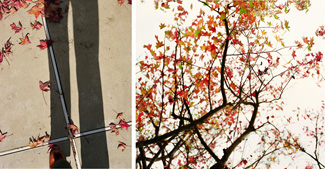
Pedestrian crossings
Someone who photographs only herself might seem self-obsessed. Someone who never quite photographs herself might be playing hard to get or painfully shy. Uta Barth is just looking. Not everyone can see what is right before her eyes—and not everyone can make others look as well. A woman's photographs can do both.
In color, she pairs photos of the sidewalk or street with trees, bare except for a handful of brown leaves or bright fruit and flowers. The tawny pavement has a crisp painterly texture, while the ripeness of red and blue stands out against a hazy network of branches. Opposites seem to attract, especially when leaves land on the street. The shadow of Barth's legs stretches out in front of her feet, artfully crossing parallel road markings and echoing the unseen tree trunks. A print's large scale and the arrangements in diptychs (or occasionally triptychs) bring the work that much closer to abstract painting, but also to a documentary record. The series implies both motion and stasis, and Barth calls it . . . to walk without destination and to see only to see.
In black and white, she works smaller and never leaves her studio. There is no overt motion at all in the chair on the floor or in the artist herself cut off by the edge or by shadow. The clustering of objects near the border gives the impression of an empty room and a print hastily made. Here, too, though, the artist advances at her own pace. Barth arranges like scenes in series, like successive points of view or instants in time, with titles like One Day and Every Day. In one pair, the artist in 1979 intrudes amid the recent present.
Naturally this is the only time one sees her body or her face. She likes every day, or the everyday, too much to accept disguises. Call it coincidence that the older pictures date from the very same years as Untitled Film Stills, by Cindy Sherman. Still, one is always conscious of Barth's presence or absence. As Postmodernism would dictate, I just cannot say which one. Personal identity is definitely at stake, as it always is when a woman photographer occupies both sides of the camera.
For Barth, though, identity is wrapped up not so much in being among women in photography as in the plain facts of walking, looking, and seeing. The pairing of shadow and trees could stand for the seer and the object of sight, but in each case she shows only what she can see without smoke and mirrors. The early work has the artfulness of formalism, while the new work has the calculated artlessness of color inkjet prints. They may even look digitally enhanced. But they just accept the camera's limitations. The contrast of ripeness and shadow stems from shallow depth of field, and a negative reversal provides the sole color manipulation. For once seeing is believing, even if seeing is also a construction of the one who sees.
The heightened sense of time and space has something in common with Darren Almond in his video of a monk at work and in the woods. Like Almond, she could well describe her subject as a "walking meditation," with her studio in place of his crowded cell. Later photographs show the studio from the outside, with traces just visible above and below the exterior wall, and from the inside, where a still life takes on jagged edges and shimmering bands. The white wall could pass for a curtain, covering the real picture and stained by shadow. The bands and edges, in turn, derive from an unusual camera angle converted digitally to a strict frontal view. Even without the ritual, Barth finds room for meditation as at once detachment, observation, and self-awareness.
The ice queen
Childhood may have lost its innocence, but the post-feminist generation still wants to live happily ever after. No wonder Rachel Hovnanian refuses to put away childish things.
In fact, she makes her own. She photographs cloud-white figurines, as crisp and translucent as ice sculpture, in chilly but also very funny domestic interiors. Hovnanian molds her actors while borrowing props from doll sets. That would explain the rotary phone, but not the empty liquor bottles on the bed or the jar labeled Valium. Either way, no one will mistake them for sex toys by Mike Kelley, Paul McCarthy, Nayland Blake, and other jaded male adults worried half to death about sex, drugs, and rock 'n' roll. Here male desire hems in a woman's world like primeval fears.
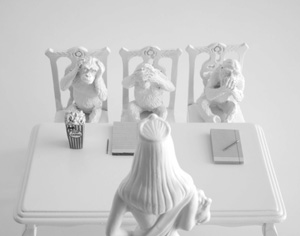 One could call her cast ice maidens, for they look ever so beautiful and aloof, and they drive a hard bargain. As the very first photograph has it, No Prenup. Maybe make that ice queens, in crowns and long dresses, clutching flowers to their chest. Yet if the eternal heroine faces front, surrounded by shopping bags, the male seen from behind examines his purchase, too. To better combine the roles of beauty queen and perfect housewife, one figurine keeps her trophies in a washer-dryer. When the going gets tough, the tough get married.
Obviously the men get the better of the deal. For a woman, marriage leads to long silent dinners across a long empty dining-room table, followed perhaps by a press conference to confess her sins. One dearly beloved stands next to a fireplace surmounted by a beloved deer's head—the perfect hunting trophy for the perfect trophy wife. Another is shackled at her ankle to a man's dog collar, like a slave to kinky sex. It may get hard to keep up appearances, faced with a cabinet of donuts, but fortunately a modern doll's house comes with some upgrades. A living doll nowadays can check Good Housekeeping online for "how to get rid of stubborn blood stains."
The photographs are still basically one-liners mired in the 1950s, although good ones, and you may get the feeling that you have heard them before. You saw that movie, maybe even lived it, and you have seen Laurie Simmons, too. It is hard to stop looking anyway, even after the laughter has died, when the toys look X-rated and the artist's casts so pristine, with one notable exception. A live woman sat in a corner, too, through the run, with her own tiara and pile of Vogue—a bit old and heavy for the part, as if she had settled there years ago and never thought to leave. And, believe it or not, the woman across from me on the bus home held a bouquet of flowers.
Like Hovnanian, "A Vernacular of Violence" disturbs suburban paradise. Despite the presence of Claire Fontaine, Lisa Kirk, and Walid Raad, the show rarely conveys a present emergency. Yet Eric Baudelaire does—at a metro stop that has somehow acquired the name Erewhon, after Samuel Butler's 1872 fictional utopia. On video, a man papers a billboard with successive views of parked cars and, ultimately, an explosion. He does not mean that, faced with terrorism, commuters should pay more attention to advertising or sit through seventy-minute art videos. Rather, political commentary could stand to learn from the glorious futility of everyone involved.
Critic victorious
I had already accepted a certain role by letting Irene Caesar in the door. I found myself in another in no time, as I leaned on the arm of a sofa to get a better look as she unpacked her camera and lighting. (I find an artist's equipment fascinating, magazines notwithstanding.) Perfect, she announced, and would I mind sitting there, one leg down and one up by the couch? Then some portraits in street clothes to put me at ease—head shots, as it turned out, so never mind what I was wearing. And now, um, time to take off my clothes.
I had already accepted a role, just by agreeing to pose. I knew little about Caesar, but who would not want to help a photographer do her job? Part of her approach, however, is clearly to make concessions to a stranger look gradual and easy. My job was to nestle a magazine, hold out one of its pages, and, scissors in hand, snip neatly but swiftly around the fashion model's body. In a few minutes I had run through plenty of pages, with plenty more left over. You try it while balancing on a narrow, rounded arm, exposing your crotch, keeping your cat at bay, and looking away from your own action and toward the camera.
Obviously I survived to tell you about it, although I cannot swear my public image has. Caesar describes the series as contemporary art critics made into contemporary art. (Well, there is one sure way to get critical attention.) I am not so certain. My pose comes closer to something more remote. I look in fact very much like Caravaggio in his Amor Victorius, a winged Cupid in Berlin with his own assortment of lecherous props.
The pose does not seem chosen with me in mind, any more than I associate Arthur C. Danto with a bowl of Cheetos, as in his pose. I do not, as it happens, caress female outlines in magazines, not even the kind published for men. I am not convinced it says all that much either about issues in contemporary art, such as the male gaze. Rather, the artifice seems itself the point. Could that alone say something disturbing about art now?
Caravaggio painted Cupid early in his career, probably in 1601, just before or after the Roman chapels that startled the Baroque into existence. He had already adopted a greater intimacy with the viewer, but not always as yet a greater naturalness, warmth, and human drama. He was, in short, on his way to upending Mannerism. And artifice is often associated with Mannerism—as are a heightened sexuality, exaggerated poses, and a deliberate restaging of myth at a certain distance from its meaning. Once such myth involves a god holding out food, if not exactly Cheetos, whether as cornucopia or temptation. Caravaggio painted that, too, around 1593.
Critics often compare the present to a kind of Neo-Mannerism, which made a show of Bronzino drawings a fresh discovery for many. Besides embracing artifice, sex, and exaggeration, Postmodernism is reliving, reworking, and struggling against Modernism, just as Mannerism struggled with the Renaissance. It is also looking for a future without settling on a movement. Would I like Caesar's photos of me any better if I were not involved—and if she had not, in violation of my privacy and jeopardizing my reputation, posted them online for all to see? I had seen her dour, white-haired woman as Delilah with the head of Samson, which frankly left me cold, although some may sense a dancer's exuberance, and I did not volunteer to pose as a critical commitment to her work. I shall relish it anyway, I suppose, if both of us become notorious.

Uta Barth ran at Tanya Bonakdar through June 19, 2010, Rachel Hovnanian at Collette Blanchard through July 1, and "A Vernacular of Violence" at Invisible-Exports through June 20. (I have updated the section on Barth for a show that ran through March 11, 2017.) I contributed the material on Irene Caesar, at the artist's request and in a slightly different form, for the catalog to a show in Russia of her critic portraits, including me. And no, it is not my habit to publish lewd pictures online or to cavort nude.